Crime Scene Cleanup Services — Certified, Compassionate, 24/7 Nationwide
After law enforcement releases a crime scene, the property owner — not the police department — is responsible for the safe cleanup and decontamination of all biological hazards left behind. Blood, bodily fluids, and tissue from violent crimes including homicide, assault, and accidental death contain bloodborne pathogens such as Hepatitis B, Hepatitis C, and HIV that pose serious health risks to anyone who enters the scene without proper training and personal protective equipment (OSHA, 29 CFR 1910.1030). Zero Trace Biohazard provides OSHA-compliant, IICRC TCST-certified crime scene cleanup for residential and commercial properties across all 50 states, 24 hours a day, every day of the year. Our team responds with full technical competence, documented regulatory compliance, and the compassion that every family and property owner deserves in the aftermath of a traumatic event. Call (XXX) XXX-XXXX now for immediate, confidential response.
TL;DR
Crime scene cleanup costs between $1,000 and $10,000+ for most residential and commercial incidents, with a national average of $3,000–$5,000 (360haz; Precision Service Experts; TACT North Atlanta). Single-room incidents with significant blood contamination average approximately $3,000, while complex multi-room scenes can exceed $10,000 (Precision Service Experts). Police do not clean crime scenes — once the scene is released by law enforcement, cleanup becomes the legal responsibility of the property owner (Quora; NCSC). Most homeowners and renters insurance policies cover crime scene cleanup as a sudden, unexpected covered peril (TRC Restoration; Sterile Pros). State crime victim compensation programs in all 50 states, administered through the Office for Victims of Crime (OVC) and NACVCB, can provide $1,000–$10,000 toward cleanup costs in qualifying situations (Sterile Pros; OVC). Zero Trace Biohazard coordinates all insurance claims and victim compensation applications on behalf of clients. OSHA 29 CFR 1910.1030 (Bloodborne Pathogen Standard) and IICRC ANSI/IICRC S540 govern all technician training and work practice requirements.
- Cost Range: $1,000–$10,000+; national average $3,000–$5,000 (360haz; TACT North Atlanta 2025)
- Scene Types: Homicide, shooting, stabbing, assault, accidental death, suicide, industrial accident
- Who Cleans: Property owner’s responsibility once police release the scene — Zero Trace responds immediately
- Certifications: OSHA 29 CFR 1910.1030, IICRC TCST (ANSI/IICRC S540), GBAC Biohazard, EPA-registered disinfectants
- Insurance: Homeowners and renters policies typically cover sudden, unexpected violent events; Zero Trace coordinates claims
- Victim Compensation: Available in all 50 states through OVC/NACVCB — $1,000–$10,000 in qualifying cases (Sterile Pros)
- Timeline: 4–8 hours (single room, standard); 1–3 days (multi-room or structural contamination)
- Privacy: Unmarked vehicles available; all details held in strict confidence
Quick Facts Table
| Detail | Info |
| Company | Zero Trace Biohazard |
| Phone | (XXX) XXX-XXXX |
| Service Area | All 50 states, residential & commercial |
| Availability | 24/7, 365 days, same-day response |
| National Average Cost | $3,000–$5,000 (360haz; TACT North Atlanta 2025) |
| Cost Range | $1,000–$10,000+ by scene type and severity |
| Hourly Rate | $150–$250 per hour (industry standard) |
| Certifications | OSHA 29 CFR 1910.1030, IICRC TCST, GBAC |
| Standard | ANSI/IICRC S540 Trauma and Crime Scene Cleanup |
| Disinfectant | EPA-registered, 99.99% pathogen kill rate |
| Insurance Coverage | Homeowners/renters — covered for sudden events |
| Victim Compensation | $1,000–$10,000 via OVC/NACVCB state programs |
| Tennessee Example | Up to $3,000 for crime scene cleanup (TN CICF) |
| Who Cleans | Property owner — police do not clean scenes |
| Timeline (Single Room) | 4–8 hours |
| Timeline (Multi-Room) | 1–3 days |
| Privacy | Unmarked vehicles, confidential service |
What Is Crime Scene Cleanup and Why Do Police Not Clean Scenes?
A widespread misconception is that law enforcement agencies clean up after themselves once an investigation concludes. In reality, police departments, sheriff’s offices, and federal agencies collect evidence and process the scene for investigative purposes only — once the scene is released back to the property owner, all biological contamination remains exactly as the incident left it (Quora; NCSC; Fleet Damage Restoration). The responsibility for safe remediation falls entirely on the property owner, landlord, or in some cases the victim’s family.
Crime scene cleanup — also referred to as crime scene biohazard remediation, trauma scene cleanup, or forensic cleaning — is the professional assessment, containment, removal, disinfection, deodorization, and documentation of all biological hazards generated by a violent crime or traumatic incident. It is legally and operationally distinct from general cleaning because the biological materials present — blood, bodily fluids, tissue, and bone fragments — are classified as potentially infectious under OSHA’s Bloodborne Pathogen Standard (29 CFR 1910.1030) and require licensed disposal as regulated biohazardous waste. Standard cleaning products do not achieve the 99.99% pathogen kill rate required for genuine decontamination, and household-grade PPE does not adequately protect against bloodborne pathogen exposure (Bio Recovery; OSHA).
Zero Trace Biohazard can begin mobilization the moment law enforcement releases the scene — 24 hours a day, seven days a week, every day of the year — so that families and property owners do not have to wait.
Types of Crime Scenes Zero Trace Biohazard Remediates
Homicide and Murder Scenes
Homicide scenes involve the most severe and widespread blood contamination of any crime scene type. Blood spatter can cover walls, ceilings, floors, furniture, and adjacent rooms. Bodily fluids and tissue may be present across a large area, and if the discovery is delayed, decomposition compounds the biological hazard. Zero Trace Biohazard’s technicians are trained specifically in homicide scene assessment — mapping the full extent of contamination including blood pooling patterns and spatter distribution — before any remediation begins. Costs for homicide scene cleanup typically fall between $3,000 and $10,000+, depending on the size of the contaminated area and the scope of structural penetration (360haz; TACT North Atlanta).
Shooting Scene Cleanup
Shooting scenes — whether involving a single victim or multiple — create a combination of blood, biological tissue, and in some cases projectile fragmentation that embeds in walls, flooring, and furnishings. Bullet entry and exit points in drywall and structural elements must be assessed for blood penetration into wall cavities and subfloor materials. When structural penetration is present, affected materials require removal and replacement — escalating both cost and project duration. Zero Trace Biohazard assesses all shooting scenes for structural contamination as a standard protocol, not an optional add-on.
Stabbing and Assault Scene Cleanup
Stabbing and sharp-force assault scenes frequently involve large volumes of blood across a defined area, with blood tracking patterns that extend beyond the primary scene into hallways, bathrooms, and other rooms. Blood contact with porous materials — carpet, padding, hardwood, upholstery — requires thorough penetration testing because surface-visible blood removal alone does not eliminate pathogen risk in absorbed materials. Zero Trace’s three-pass decontamination protocol ensures that all porous surfaces are tested and treated to the depth of contamination.
Accidental Death and Trauma Scene Cleanup
Accidental deaths — fatal falls, industrial accidents, vehicle incidents within structures, and similar events — generate the same biological hazards as violent crime scenes and require identical levels of professional remediation. Zero Trace Biohazard responds to accidental death scenes with the same 24/7 urgency, technical protocol, and compassionate approach as any other crime scene engagement.
Suicide Scene Cleanup
Suicide scenes are addressed under Zero Trace Biohazard’s dedicated Trauma and Suicide Cleanup service and share substantial overlap with crime scene cleanup protocols. Many state victim compensation programs specifically cover suicide scene cleanup costs when the incident is reported to law enforcement. Zero Trace handles the full remediation and documentation process and can direct families to applicable state compensation resources. See our Trauma and Suicide Cleanup page for full detail.
Industrial and Commercial Crime Scenes
Violent incidents in commercial settings — offices, retail spaces, warehouses, restaurants, and multi-unit buildings — present the same biological hazards as residential crime scenes with the additional complexity of larger affected areas, multiple access points, HVAC systems that can spread contamination, and business-continuity urgency. Zero Trace Biohazard’s commercial crime scene response minimizes operational downtime while ensuring full regulatory compliance and complete decontamination documentation for insurance and liability purposes.
Health Risks at Crime Scenes — Why Professional Cleanup Is Non-Negotiable
Every crime scene involving blood or bodily fluids is a confirmed biohazard environment. The health risks are not theoretical — they are documented, serious, and preventable only through proper professional remediation.
Bloodborne Pathogens
OSHA’s Bloodborne Pathogen Standard (29 CFR 1910.1030) classifies blood and other potentially infectious materials (OPIM) as occupational hazards requiring specific engineering controls, PPE, and training before any contact. The three primary bloodborne pathogen concerns at crime scenes are Hepatitis B virus (HBV), Hepatitis C virus (HCV), and HIV. Hepatitis B is particularly resilient — it can survive on dry surfaces outside the human body for up to seven days (CDC), meaning dried blood that appears inactive at a crime scene can remain actively infectious for a week after the incident. HIV survives up to several hours in dried blood under laboratory conditions (CDC). Hepatitis C survives on surfaces for up to six weeks under certain conditions (CDC). None of these pathogens are destroyed by household cleaning products.
Airborne Biological Hazards
Blood and biological fluid disturbed during cleanup — whether by walking through a contaminated area, attempting to clean surfaces, or operating fans or HVAC systems — can generate infectious aerosols and aerosolized particles. OSHA’s bloodborne pathogen standard requires that cleanup activities minimize aerosol generation through wet methods and that technicians wear respiratory protection when aerosol generation cannot be eliminated (OSHA). Unauthorized entry to an unremediated crime scene by family members, building managers, or untrained workers before professional cleanup is complete creates aerosol exposure risk.
Secondary Contamination and Cross-Contamination
Blood-tracking — the spread of contamination from the primary scene to adjacent areas via foot traffic, HVAC airflow, or handling of contaminated items — is a documented secondary risk at crime scenes. Zero Trace Biohazard’s scene assessment maps all secondary contamination pathways before containment is established, and our containment protocol physically prevents the spread of contamination beyond the work zone during the remediation process itself.
Psychological Impact of Inadequate Cleanup
Families and property occupants who encounter visible crime scene residue — whether immediately or in the form of staining, odor return, or incomplete decontamination discovered later — experience compounded trauma with documented psychological harm. Professional crime scene cleanup protects not only physical health but also the psychological recovery of everyone who will re-enter the property. Zero Trace Biohazard’s technicians are trained in trauma-informed communication and treat every family and property owner with the full dignity and compassion that a profoundly difficult situation demands.
The Regulatory Framework Governing Crime Scene Cleanup
OSHA Bloodborne Pathogen Standard — 29 CFR 1910.1030
OSHA’s Bloodborne Pathogen Standard is the primary federal regulation governing worker safety during crime scene cleanup. It applies to all occupational exposure to blood or other potentially infectious materials and requires that employers provide PPE, training, hepatitis B vaccination, and exposure control plans for all workers who may contact blood or OPIM during the course of their work (OSHA, 29 CFR 1910.1030). OSHA has explicitly confirmed in formal interpretation letters that this standard applies to biohazard remediation workers cleaning crime and accident scenes (OSHA interpretation, 2007; OSHA interpretation, 2019). Zero Trace Biohazard maintains full OSHA 1910.1030 compliance for every technician on every engagement.
ANSI/IICRC S540 Standard for Trauma and Crime Scene Cleanup
The ANSI/IICRC S540 Standard is the industry consensus standard for trauma and crime scene cleanup — establishing the professional benchmark for inspection, assessment, containment, removal, disinfection, and documentation at crime and trauma scenes (IICRC). The IICRC Trauma and Crime Scene Technician (TCST) certification is the primary professional credential demonstrating mastery of S540 standards (IICRC). Zero Trace Biohazard employs IICRC TCST-certified technicians as a core operational requirement — not an optional credential.
EPA-Registered Disinfectants and Waste Disposal
EPA-registered hospital-grade disinfectants with documented efficacy against HIV-1, HBV, and HCV are required for all surfaces contacted during crime scene cleanup. All biohazardous waste — blood, fluids, contaminated materials — must be packaged in certified biohazard containers, labeled per OSHA 1910.1030, manifested, and transported to licensed medical waste disposal facilities. Disposal in the regular waste stream is illegal under federal and state medical waste regulations and creates direct liability for the property owner as the waste generator.
State Licensing Requirements
Many states impose additional licensing or registration requirements on crime scene and biohazard cleanup companies operating within their borders, beyond federal OSHA and EPA requirements. These vary significantly by state — some require specific contractor licenses, others require registration with state environmental or health departments, and some require proof of biohazardous waste transporter credentials. Zero Trace Biohazard maintains all applicable state-specific licenses and registrations in every state in which we operate.
Crime Scene Cleanup Cost — Full Breakdown
Cost by Scene Type
| Scene Type | Estimated Cost Range | Notes |
| Single-room blood cleanup | $1,000–$3,000 | Limited contamination, no structural penetration |
| Homicide / shooting — single room | $3,000–$7,000 | Significant spatter, possible structural penetration |
| Homicide / shooting — multi-room | $5,000–$15,000+ | Extended contamination, structural assessment required |
| Stabbing / assault scene | $1,500–$5,000 | Volume and spread dependent |
| Accidental death — prompt discovery | $1,500–$4,000 | Comparable to homicide scene of similar size |
| Commercial / industrial crime scene | $3,000–$25,000+ | Size, HVAC, and structural scope dependent |
| Hourly rate | $150–$250 per hour | Applied to complex or extended engagements |
Key Cost Drivers
The following factors most significantly determine the final cost of a crime scene cleanup engagement and should be communicated to Zero Trace Biohazard at first contact for an accurate estimate: the type of incident (homicide generates more extensive contamination than assault); the number of rooms and total square footage affected; whether blood has penetrated porous structural materials including carpet padding, subfloor, or drywall; time elapsed since the incident (longer elapsed time increases pathogen persistence and structural penetration); presence of HVAC contamination requiring duct assessment; and the number of contamination pathways — including secondary areas reached by blood tracking.
Comparison Table — Incident Severity vs. Cost and Scope
| Factor | Minor Incident | Moderate Incident | Severe / Extended |
| Estimated Cost | $1,000–$3,000 | $3,000–$7,000 | $7,000–$25,000+ |
| Rooms Affected | 1 | 1–3 | 3+ |
| Structural Removal | Rare | Possible | Likely |
| HVAC Contamination | Unlikely | Possible | Likely in severe cases |
| Timeline | 4–8 hours | 1–2 days | 2–3+ days |
| Insurance Complexity | Lower | Moderate | Higher |
Who Pays for Crime Scene Cleanup?
Homeowners and Renters Insurance
Most standard homeowners and renters insurance policies cover crime scene cleanup when the triggering event — homicide, assault, accidental death — constitutes a sudden, unexpected covered peril under the policy (TRC Restoration; Sterile Pros). Coverage is subject to the policy’s deductible and applicable limits. Some policies classify biohazard remediation under property damage coverage; others include it under extended coverage endorsements. Zero Trace Biohazard works directly with insurance carriers on behalf of policyholders — we handle claim documentation, billing, and insurer coordination so families are not required to navigate this process while dealing with a traumatic loss.
State Crime Victim Compensation Programs
All 50 states operate crime victim compensation programs through the Office for Victims of Crime (OVC) and the National Association of Crime Victim Compensation Boards (NACVCB). These programs provide financial assistance for crime scene cleanup costs to qualifying victims and families, typically ranging from $1,000 to $10,000 depending on the state (Sterile Pros; OVC). For example, Tennessee’s Criminal Injuries Compensation Fund provides up to $3,000 specifically for crime scene cleanup (TN CICF). The crime must be reported to law enforcement to qualify, and applications are time-limited in most states. Zero Trace Biohazard assists clients in identifying the applicable program in their state and provides the documentation required for the application.
Property Owner and Landlord Responsibility
When a crime occurs in a rental property, the property owner is legally responsible for ensuring the unit is safely remediated and returned to habitable condition for future occupants — regardless of whether the tenant, their family, or their estate cooperates or contributes (360haz; SceneCleanMN; DryFast911). Landlords cannot legally rent a biologically contaminated unit. In many states, known biohazard contamination must be disclosed to prospective tenants and buyers. Zero Trace Biohazard provides the remediation documentation required for landlord liability protection and property disclosure compliance.
Out-of-Pocket and Estate Payment
When insurance and victim compensation programs do not fully cover costs — or where the incident does not qualify for compensation programs — the property owner, deceased’s estate, or surviving family may bear direct responsibility. Zero Trace Biohazard provides itemized invoices formatted for estate accounting and legal proceedings and can discuss payment arrangements on a case-by-case basis.
DIY vs. Professional Crime Scene Cleanup
Attempting to clean a crime scene without professional training, certified PPE, EPA-registered disinfectants, and licensed waste disposal is dangerous and counterproductive — and in many cases illegal under state medical waste regulations.
Comparison Table — DIY vs. Zero Trace Biohazard
| Factor | DIY Attempt | Zero Trace Biohazard |
| Bloodborne pathogen risk | High — HBV survives 7 days on dry surfaces (CDC) | Eliminated with full Level B PPE and OSHA 1910.1030 protocol |
| OSHA compliance | Non-compliant | Fully compliant — 29 CFR 1910.1030 |
| Pathogen kill rate | Uncertain — consumer products inadequate | 99.99% — EPA-registered hospital-grade disinfectants |
| Structural contamination detection | None — penetration not visible to the eye | Full assessment with below-surface testing |
| Aerosol exposure control | None — household vacuums generate aerosols | Wet methods throughout; HEPA vacuum only |
| Biohazardous waste disposal | Illegal — regular waste stream prohibited | Certified containers, manifested transport, licensed facility |
| Insurance claim support | None — may void coverage | Full documentation, direct insurer coordination |
| Victim compensation filing | Not supported | Zero Trace assists with state program applications |
| Emotional burden on family | Severe — unnecessary secondary trauma | Fully managed by certified, compassionate professionals |
| ANSI/IICRC S540 compliance | None | Full compliance on every engagement |
How to Choose the Right Crime Scene Cleanup Company
Not all crime scene cleanup companies are equally qualified, and choosing the wrong company can result in incomplete decontamination, insurance claim complications, and significant ongoing health and legal liability. Zero Trace Biohazard recommends evaluating any prospective company against the following criteria before authorizing any work.
Certifications and Training
Verify that the company employs IICRC TCST-certified technicians and maintains current OSHA 29 CFR 1910.1030 compliance for all workers (BELFOR; 360haz). IICRC TCST certification is based on the ANSI/IICRC S540 standard — the nationally recognized benchmark for trauma and crime scene cleanup. Ask specifically for certification documentation, not just a verbal assurance.
Licensing and Waste Disposal Credentials
Confirm that the company holds all required state licenses or registrations for biohazard cleanup and biohazardous waste transport in your jurisdiction. Ask for the company’s biohazardous waste transporter license number and the name of the licensed disposal facility used. A company unable to provide these details cannot legally transport or dispose of biohazardous waste from your property (OSHA; EPA).
Insurance and Documentation
A qualified crime scene cleanup company carries general liability insurance and workers’ compensation coverage and provides a complete post-remediation documentation package — including a work log, waste disposal manifests, EPA-registered disinfectant data sheets, and a signed completion certificate. This documentation is essential for insurance claims, victim compensation applications, property disclosure, and landlord liability protection (DKI Services; 360haz).
Compassion and Communication
Technical competence and regulatory compliance are necessary but not sufficient. The right company communicates clearly, treats families with dignity and respect, does not require graphic descriptions of the scene from family members, offers discretion with unmarked vehicles if requested, and keeps property owners informed throughout the process (BELFOR; HuusoBio). Zero Trace Biohazard trains all client-facing personnel in trauma-informed communication as a core operational standard.
The Zero Trace Crime Scene Cleanup Process (Step by Step)
Step 1 — Immediate Response and Scene Release Coordination
Zero Trace Biohazard responds to crime scene calls 24/7 with immediate dispatch. We coordinate directly with law enforcement to confirm the scene has been officially released before mobilization. We never enter or begin work on a scene that has not been released by the relevant authority. Once release is confirmed, our team mobilizes immediately — families and property owners do not need to wait.
Step 2 — Scene Assessment and Contamination Mapping
Certified technicians conduct a comprehensive scene assessment upon arrival — mapping all visible blood and biological contamination, testing adjacent surfaces and structural materials for hidden penetration, evaluating secondary contamination pathways including HVAC and adjacent rooms, and documenting conditions photographically for insurance and compliance purposes. The assessment generates the full project scope, itemized cost estimate, and insurance documentation package before any remediation begins.
Step 3 — Site Containment and PPE Deployment
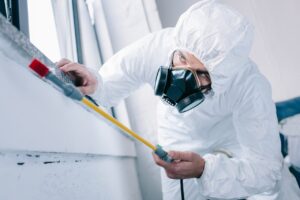
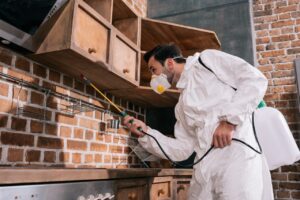
The crime scene work zone is fully contained using polyethylene sheeting, negative air pressure HEPA units, and critical barriers at all access points. HVAC registers within the work zone are sealed to prevent cross-contamination. All technicians don OSHA 1910.1030-compliant PPE — full-face respirators, chemical-resistant coveralls, and nitrile or butyl-rubber gloves — before entering the work zone.
Step 4 — Removal of Biological Material and Contaminated Contents
All biological material — blood, bodily fluids, tissue, and bone fragments — is removed using wet methods to suppress aerosol generation, per OSHA 1910.1030 and ANSI/IICRC S540 requirements. Contaminated soft goods including carpet, padding, mattresses, and upholstered furniture are bagged in certified biohazard containers and removed from the property. When structural materials have been penetrated by blood or fluids, those materials are carefully removed, documented, and packaged for licensed disposal.
Step 5 — Deep Cleaning and Hospital-Grade Disinfection
All surfaces in the work zone undergo Zero Trace’s standard three-pass decontamination protocol: initial application of EPA-registered hospital-grade disinfectant, mechanical scrubbing to physically disrupt biofilm and surface contamination, and a final disinfectant application confirming a 99.99% kill rate against HBV, HCV, HIV, MRSA, and all other bloodborne and airborne pathogens present. All EPA-registered products are documented by name and EPA registration number in the project file.
Step 6 — Odor Elimination
Odor from blood and bodily fluids — particularly where pooling or extended contact with porous materials has occurred — is eliminated using ozone treatment (in unoccupied spaces), hydroxyl generators, and thermal fogging with EPA-registered deodorizing agents. Surface deodorizers are not used in lieu of source removal. Odor treatment occurs only after all contaminated materials have been physically removed, ensuring permanent rather than temporary odor resolution.
Step 7 — Final Inspection, Clearance, and Documentation
Post-remediation inspection confirms that all biological contamination has been eliminated and odor has been permanently resolved. Zero Trace Biohazard delivers a complete documentation package: scene assessment report, work log, materials removed log, waste disposal manifests, EPA-registered disinfectant product data sheets, and a signed completion certificate. This package is formatted for homeowners insurance claim submission, renter’s insurance claims, victim compensation program applications, landlord liability documentation, and future property disclosure requirements.
Is This Service Right for You?
Best For:
- Families who have lost a loved one to violent crime and need compassionate, confidential professional remediation before re-entering the home
- Property owners and landlords whose property is the site of a violent crime, accidental death, or trauma event and who are legally required to remediate before re-occupancy
- Property managers of commercial and multi-unit buildings where a violent crime, industrial accident, or death has occurred
- Estate executors and attorneys managing a deceased person’s property who need full remediation and documentation for estate and disclosure purposes
- Insurance adjusters and claims professionals requiring a certified remediation partner with insurer-accepted documentation practices
- Real estate professionals managing a property sale that requires disclosure of a prior death or violent event and needs remediation certification documentation
Not the Right Fit:
- General housekeeping, standard deep cleaning, or post-move-out cleaning with no biohazard contamination present
- Unattended death or decomposition scenes requiring the extended protocols of our dedicated Unattended Death Cleanup service
- Mold, asbestos, or lead paint removal (see our dedicated environmental service pages)
FAQ Section
How much does crime scene cleanup cost? Crime scene cleanup costs range from $1,000 to $10,000+ for most residential and commercial incidents, with a national average of $3,000–$5,000 (360haz; TACT North Atlanta 2025). Single-room incidents with significant blood contamination average approximately $3,000; complex multi-room scenes with structural contamination can exceed $10,000. Hourly rates run $150–$250. Call Zero Trace Biohazard at (XXX) XXX-XXXX for a free on-site assessment and itemized estimate.
Do police clean up crime scenes after they finish investigating? No. Law enforcement agencies process crime scenes for evidence collection only — once the scene is released back to the property owner, all biological contamination remains in place and cleanup becomes the legal responsibility of the property owner or their designated representative (Quora; NCSC). Zero Trace Biohazard can begin mobilization the moment law enforcement releases the scene, 24 hours a day, seven days a week, nationwide.
Does homeowners insurance cover crime scene cleanup? Yes, in most cases. Standard homeowners and renters insurance policies typically cover crime scene cleanup when the incident constitutes a sudden, unexpected covered peril (TRC Restoration; Sterile Pros). Coverage is subject to policy deductibles and limits. Zero Trace Biohazard works directly with insurance carriers, handles all claim documentation and billing, and can coordinate the claim on the policyholder’s behalf. Call (XXX) XXX-XXXX and our team will begin insurance coordination immediately.
Will state victim compensation programs pay for crime scene cleanup? Yes. All 50 states operate crime victim compensation programs through the Office for Victims of Crime (OVC) and the NACVCB that can provide $1,000–$10,000 toward crime scene cleanup costs in qualifying situations (Sterile Pros; OVC). The incident must be reported to law enforcement to qualify, and applications are time-limited in most states. Zero Trace Biohazard assists clients in identifying and applying for the applicable program in their state — call (XXX) XXX-XXXX for state-specific guidance.
How long does crime scene cleanup take? A single-room scene with standard blood contamination typically takes 4–8 hours from containment to final documentation (ASAP Restoration; Instagram crime scene cleanup). Multi-room scenes or scenes with structural material penetration take 1–3 days. Particularly complex or large commercial scenes can require up to a week. Zero Trace Biohazard provides a timeline estimate as part of the initial scene assessment before any work begins.
Can I clean up a crime scene myself? While technically legal in limited situations, DIY crime scene cleanup is strongly discouraged and operationally unsafe. Hepatitis B survives on dry surfaces for up to seven days (CDC), meaning dried blood remains actively infectious long after the event. Household cleaning products do not achieve the 99.99% pathogen kill rate required for safe decontamination. Disposal of biohazardous waste in the regular waste stream is illegal under federal and most state regulations. Attempting cleanup also creates aerosol exposure risk and may void insurance coverage (Sterile Pros; West Coast Fire and Water).
Who is responsible for crime scene cleanup in a rental property? The property owner — not the tenant’s family — is legally responsible for ensuring the rental unit is safely remediated and returned to habitable condition (360haz; SceneCleanMN). In most U.S. jurisdictions, landlords cannot legally rent a biologically contaminated unit, and known contamination must be disclosed to prospective tenants and buyers. Zero Trace Biohazard serves both residential landlords and commercial property owners nationwide and provides the remediation documentation required for legal compliance and property disclosure.
What certifications should a crime scene cleanup company have? A qualified crime scene cleanup company must employ IICRC Trauma and Crime Scene Technician (TCST)-certified workers trained to the ANSI/IICRC S540 standard, maintain full OSHA 29 CFR 1910.1030 (Bloodborne Pathogen Standard) compliance, hold biohazardous waste transporter credentials and state licenses applicable in the relevant jurisdiction, and use only EPA-registered hospital-grade disinfectants (IICRC; OSHA; BELFOR). Zero Trace Biohazard holds all required federal and state certifications and credentials nationwide.
Does crime scene cleanup include odor removal? Yes. Zero Trace Biohazard’s crime scene cleanup service includes complete molecular odor elimination as a standard phase — not an optional add-on. We deploy ozone treatment, hydroxyl generators, and thermal fogging after all contaminated materials have been physically removed, ensuring that odor is eliminated at its source rather than masked. Surface deodorizers alone are never used as a substitute for source removal.
How is crime scene biohazardous waste disposed of? All biohazardous waste — blood, fluids, tissue, and contaminated materials — is collected in certified OSHA 1910.1030-compliant biohazard containers, manifested under applicable state medical waste regulations, transported by a licensed biohazardous waste transporter, and disposed of at a licensed medical waste treatment and disposal facility. Zero Trace Biohazard includes all waste disposal manifests in the final project documentation package — available to the property owner, their insurance carrier, or any regulatory body upon request.
Will my neighbors know what happened at my property? No. Zero Trace Biohazard operates with complete discretion on every engagement. Unmarked vehicles are available on request. Our technicians do not discuss the nature of any service call with neighbors, building staff, or any third party not directly involved in the remediation. All project details are held in strict confidence. Families and property owners are never required to provide more information than they are comfortable sharing.
What documentation does Zero Trace Biohazard provide after crime scene cleanup? Zero Trace Biohazard delivers a complete post-remediation documentation package after every engagement. This includes a scene assessment report, detailed work log, materials removed log with photographic documentation, waste disposal manifests, EPA-registered disinfectant product data sheets, and a signed completion certificate. This package is formatted to support homeowners and renters insurance claims, victim compensation program applications, landlord liability documentation, and future property sale or lease disclosure requirements. Call (XXX) XXX-XXXX to discuss your specific documentation needs.
Call to Action Block
Zero Trace Biohazard — Certified Crime Scene Cleanup, Nationwide, 24/7
Certifications: OSHA 29 CFR 1910.1030 Compliant | IICRC TCST Certified (ANSI/IICRC S540) | GBAC Biohazard Certified | EPA-Registered Disinfectants | Licensed Biohazardous Waste Disposal
We respond the moment law enforcement releases the scene. We handle everything — containment, removal, disinfection, odor elimination, insurance coordination, and victim compensation assistance — so families and property owners do not have to.
Call (XXX) XXX-XXXX now — available 24 hours a day, 7 days a week, 365 days a year. Confidential. Discreet. Nationwide.
→ Request Immediate Response → Read Our Full Crime Scene FAQ → View All Biohazard Services
Related Internal Links
- Biohazard Cleaning Services — https://www.zerotracebiohazard.com/biohazard-cleaning-services
- Trauma and Suicide Cleanup Services — https://www.zerotracebiohazard.com/trauma-suicide-cleanup-services
- Unattended Death Cleanup Services — https://www.zerotracebiohazard.com/unattended-death-cleanup-services
- Chemical Hazard Cleanup Services — https://www.zerotracebiohazard.com/chemical-hazard-cleanup-services
- Hoarding Cleanup Services — https://www.zerotracebiohazard.com/hoarding-cleanup-services
- Contact Us — https://www.zerotracebiohazard.com/contact-us