Unattended Death Cleanup Services — Certified, Compassionate, 24/7 Nationwide
When a person passes away and is not discovered for hours, days, or weeks, the resulting biological contamination — decomposition fluids, bloodborne pathogens, airborne bacteria, and persistent odor — poses severe health risks and requires immediate professional intervention that goes far beyond ordinary cleaning. Zero Trace Biohazard provides OSHA-certified unattended death cleanup services for residential homes, apartments, commercial properties, and multi-unit buildings across all 50 states, 24 hours a day, every day of the year. Our technicians respond with discretion, compassion, and full regulatory compliance — handling everything from scene assessment and biohazard removal through structural decontamination, odor elimination, and final documentation. Call (XXX) XXX-XXXX now for immediate, confidential assistance.
Get Immediate Help — Confidential Unattended Death Cleanup Response, 24/7 Nationwide
Our certified team responds fast. Share your details for a discreet, compassionate assessment.
TL;DR
Unattended death cleanup costs between $2,500 and $25,000+, with a national average of $2,500–$10,000 depending on how long the body was undiscovered, the extent of structural penetration by decomposition fluids, and property size (Space City Sanitizers; ESS Remodel). Hourly rates average $200–$300 per hour (Fixr 2025). The longer a body goes undiscovered, the more decomposition fluids penetrate subfloors, drywall, and structural materials — dramatically increasing scope and cost. Zero Trace Biohazard handles insurance claim coordination directly. Most homeowners and renters policies cover unattended death cleanup when caused by a sudden, unexpected event (AM Response). State crime victim compensation programs through the Office for Victims of Crime (OVC) may also apply. OSHA 29 CFR 1910.1030 (Bloodborne Pathogen Standard) governs technician training and PPE requirements. Certified cleanup by IICRC TCST-trained and GBAC-certified technicians is the only safe, legal, and insurance-compliant approach.
Cost Range:
$2,500–$25,000+; national average $2,500–$10,000; hourly rate $200–$300 (Fixr 2025; Space City Sanitizers)
Cost Drivers:
Days undiscovered, temperature, structural material penetration, property size, required demolition
Service Area:
All 50 states, residential and commercial, 24/7 same-day response
Certifications:
OSHA 29 CFR 1910.1030, IICRC Trauma and Crime Scene Technician (TCST), GBAC Biohazard, EPA-registered disinfectants
Insurance:
Homeowners and renters policies often cover sudden, unexpected events; Zero Trace coordinates claims directly
Victim Compensation:
All 50 states operate crime victim compensation programs through OVC/NACVCB that may cover cleanup costs
Privacy:
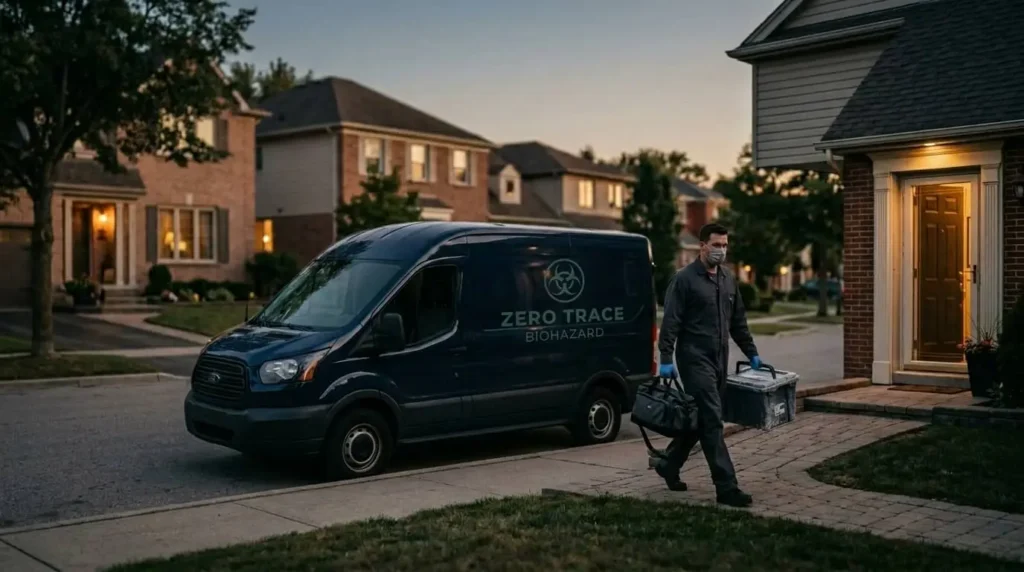
Unmarked vehicles, full confidentiality, no disclosure to neighbors or third parties
Structural Scope:
May include removal of carpet, subfloor, drywall, and furnishings where decomposition fluids have penetrated
Quick Facts Table
| Detail | Info |
|---|---|
| Company | Zero Trace Biohazard |
| Phone | (XXX) XXX-XXXX |
| Service Area | All 50 states, residential & commercial |
| Availability | 24/7, 365 days, same-day response |
| National Average Cost | $2,500–$10,000 (Space City Sanitizers) |
| Hourly Rate | $200–$300 per hour (Fixr 2025) |
| Extended Decomposition | $10,000–$25,000+ (whole-property remediation) |
| Certifications | OSHA 29 CFR 1910.1030, IICRC TCST, GBAC |
| Disinfectant Standard | EPA-registered, 99.99% pathogen kill rate |
| Insurance | Homeowners/renters — covered for sudden events (AM Response) |
| Victim Compensation | Available in all 50 states via OVC/NACVCB |
| Privacy | Unmarked vehicles, confidential service |
| Structural Work | Subfloor, drywall, carpet removal as needed |
| Odor Removal | Ozone treatment, hydroxyl generators, thermal fogging |
| Typical Completion | 4–8 hrs (single room); 1–3 days (multi-room/extended decomp) |
| Follow-Up | Post-clearance inspection and full documentation package |
What Is Unattended Death Cleanup and Why Is Professional Service Required?
An unattended death — also called an undiscovered death or death by decomposition — occurs when a person dies and their body is not found immediately. This can happen in private residences, apartments, hotel rooms, offices, or any occupied space. The time between death and discovery can range from several hours to several weeks, and the longer that interval, the more severe and far-reaching the biological contamination becomes.
Unlike a sudden death where a body is discovered promptly and removed quickly by authorities, an unattended death involves active decomposition — a biological process in which the body’s cells break down, fluids are released, gases accumulate, and bacteria multiply at an exponential rate. The resulting scene contains bloodborne pathogens, decomposition fluids, airborne biological particles, and — in extended cases — insect activity that spreads contamination beyond the immediate area. These hazards cannot be addressed with household cleaning products, and attempting to clean the scene without proper PPE, OSHA-compliant protocols, and licensed waste disposal exposes workers and future occupants to serious infectious disease risk (360haz; OSHA).
Professional unattended death cleanup requires OSHA 29 CFR 1910.1030 (Bloodborne Pathogen Standard) compliance, full personal protective equipment, EPA-registered hospital-grade disinfectants with a 99.99% pathogen kill rate, HEPA air filtration, structural assessment for deep contamination, and certified disposal of all biohazardous waste. Zero Trace Biohazard’s technicians are trained and certified to execute every one of these requirements safely, legally, and compassionately.
The Stages of Human Decomposition and Their Impact on Cleanup Scope
Understanding decomposition stages is critical to understanding why cleanup cost and complexity increase so sharply with time. The five recognized stages of human decomposition directly determine the scope of remediation required (Trauma Services; Aftermath Services).
Stage 1
Fresh (Hours 0–72)
In the first 24–72 hours after death, internal organs begin to decompose while the external body shows minimal visible change. Odor is typically minimal at this stage. Cleanup at this stage is generally limited to the immediate area of death, involves minimal structural penetration, and falls at the lower end of the cost range — typically $2,500–$5,000 (ESS Remodel).
Stage 2
Bloat (Days 3–10)
Beginning around days 3–5, the body starts to bloat as bacteria produce gases within body cavities. Blood and decomposition fluids begin to purge from body orifices. A strong, distinctive odor becomes detectable and starts to permeate porous surfaces including carpet, carpet padding, subflooring, and nearby walls. At this stage, structural contamination begins and cleanup scope expands significantly (Exit Cleanup; Aftermath Services).
Stage 3
Active Decay (Days 10–25)
This is the most intense period of decomposition. The body loses the greatest mass as soft tissues liquefy and fluids migrate rapidly into surrounding materials. Decomposition fluids can penetrate through carpet and padding into wooden subfloors, through drywall, and into wall cavities. Insect activity — particularly fly larvae — can spread biological contamination beyond the primary death area. Cleanup at this stage routinely requires removal and replacement of structural materials and significantly increases cost (BioTechs Online; PDQ Fire Water Damage).
Stage 4
Advanced Decay and Beyond (Weeks 4+)
In extended undiscovered deaths — weeks to months — decomposition fluids may penetrate multiple layers of flooring, reach concrete substructures, migrate through plumbing chases, or affect HVAC systems. Full remediation at this stage can require demolition and reconstruction of significant portions of the structure. Projects at this severity level can reach $25,000 or more (AM Response; Fixr).
Health Risks of Unattended Death Scenes
Every unattended death scene presents a constellation of biological hazards that are invisible to the naked eye and acutely dangerous without proper protective equipment and decontamination protocols.
Bloodborne Pathogens
Decomposition releases blood and bodily fluids that may carry Hepatitis B, Hepatitis C, and HIV. OSHA’s Bloodborne Pathogen Standard (29 CFR 1910.1030) classifies these as serious occupational hazards requiring engineering controls, PPE, and training before any contact (OSHA). Hepatitis B can survive outside the body for up to seven days on surfaces, making seemingly dry contamination still infectious (CDC).
Airborne Biological Contaminants
As decomposition gases accumulate and fluids evaporate, biological particulates become airborne. These include bacterial endotoxins, mold spores that colonize decomposition fluids, and aerosolized pathogenic organisms. Without HEPA filtration and negative air pressure containment, these particles migrate through HVAC systems and spread contamination to adjacent rooms (360haz; PDQ Fire Water Damage).
Structural and Environmental Contamination
Decomposition fluids are highly corrosive and penetrate porous materials rapidly. Carpet, padding, hardwood, plywood subfloor, OSB, concrete, and drywall can all absorb decomposition fluids — and once absorbed, standard surface disinfection is insufficient. Affected structural materials must be tested, and if contamination has penetrated beyond the surface, those materials must be removed and replaced (Aftermath Services; Bio Recovery).
Persistent Odor as an Ongoing Hazard
Decomposition odor is not merely unpleasant — it is a symptom of ongoing biological contamination. Odor that is not professionally eliminated at its source can persist for years. In documented cases, decomposition odor has resurfaced three years after an event when only surface cleaning was performed without addressing subfloor contamination (SceneCleanMN). Only professional odor remediation using ozone generators, hydroxyl generators, and thermal fogging — combined with complete source removal — achieves permanent elimination.
Health Risks of Unattended Death Scenes
Every unattended death scene presents a constellation of biological hazards that are invisible to the naked eye and acutely dangerous without proper protective equipment and decontamination protocols.
Bloodborne Pathogens
Decomposition releases blood and bodily fluids that may carry Hepatitis B, Hepatitis C, and HIV. OSHA’s Bloodborne Pathogen Standard (29 CFR 1910.1030) classifies these as serious occupational hazards requiring engineering controls, PPE, and training before any contact (OSHA). Hepatitis B can survive outside the body for up to seven days on surfaces, making seemingly dry contamination still infectious (CDC).
Airborne Biological Contaminants
As decomposition gases accumulate and fluids evaporate, biological particulates become airborne. These include bacterial endotoxins, mold spores that colonize decomposition fluids, and aerosolized pathogenic organisms. Without HEPA filtration and negative air pressure containment, these particles migrate through HVAC systems and spread contamination to adjacent rooms (360haz; PDQ Fire Water Damage).
Structural and Environmental Contamination
Decomposition fluids are highly corrosive and penetrate porous materials rapidly. Carpet, padding, hardwood, plywood subfloor, OSB, concrete, and drywall can all absorb decomposition fluids — and once absorbed, standard surface disinfection is insufficient. Affected structural materials must be tested, and if contamination has penetrated beyond the surface, those materials must be removed and replaced (Aftermath Services; Bio Recovery
Persistent Odor as an Ongoing Hazard
Decomposition odor is not merely unpleasant — it is a symptom of ongoing biological contamination. Odor that is not professionally eliminated at its source can persist for years. In documented cases, decomposition odor has resurfaced three years after an event when only surface cleaning was performed without addressing subfloor contamination (SceneCleanMN). Only professional odor remediation using ozone generators, hydroxyl generators, and thermal fogging — combined with complete source removal — achieves permanent elimination.
What Unattended Death Cleanup Includes — Full Scope of Services
Zero Trace Biohazard’s unattended death cleanup service is comprehensive. No part of the remediation process is outsourced or left incomplete. The following scope reflects what is included in every service engagement.
Scene Assessment and Documentation
Before any cleaning begins, our certified technicians conduct a thorough scene assessment to map the full extent of contamination — including testing of adjacent rooms, HVAC systems, wall cavities, and subfloor areas that may not be visibly contaminated but have been reached by decomposition fluids or airborne particles. The assessment drives the project scope, cost estimate, and insurance documentation package.
Containment and PPE
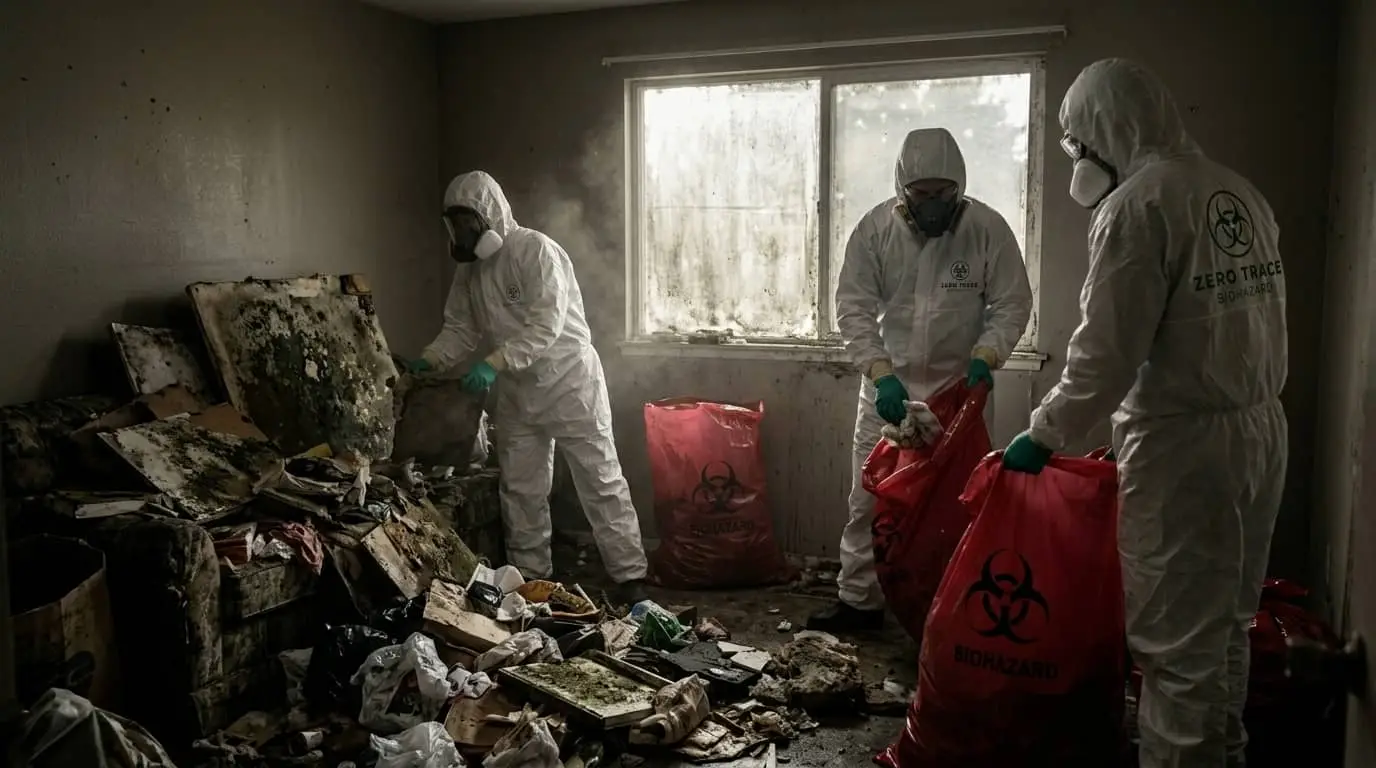
The affected area is fully contained using polyethylene sheeting, negative air pressure units with HEPA filtration, and critical barriers at all entry points. All HVAC registers within the work zone are sealed to prevent cross-contamination. Technicians wear Level B or Level C PPE depending on scene severity — including full-face respirators, chemical-resistant suits, and nitrile or butyl-rubber gloves.
Removal of Biohazardous Materials
All visible biological material — decomposition fluids, tissue, bodily fluids, blood — is removed using specialized equipment and wet methods to suppress aerosols. Contaminated soft goods including carpet, carpet padding, mattresses, upholstered furniture, and clothing are bagged in certified biohazard containers and removed from the property. When structural materials including subfloor, drywall, or cabinetry have been penetrated by decomposition fluids, those materials are removed and disposed of per federal and state medical waste regulations.
Deep Cleaning and Hospital-Grade Disinfection
Once all visible contamination and compromised materials have been removed, all surfaces in the work zone undergo a full three-pass decontamination protocol: initial EPA-registered disinfectant application, mechanical scrubbing, and a final disinfectant application achieving a 99.99% pathogen kill rate. Walls, ceilings, floors, fixtures, and all hard surfaces are treated.
Odor Remediation
Odor elimination is a distinct, essential phase — not a byproduct of cleaning. Zero Trace Biohazard uses a combination of ozone treatment (in unoccupied spaces), hydroxyl generators, thermal fogging with EPA-registered deodorizing agents, and HEPA air scrubbing to eliminate odor molecules at the molecular level. Surface deodorizers alone are not used because they mask rather than eliminate odor sources. In cases with structural penetration, source removal is completed before odor treatment begins, because no treatment can permanently eliminate odor when the contaminated material remains in place.
Structural Repair Coordination
When structural demolition is required — removal of subfloor, drywall, or other building components — Zero Trace Biohazard documents all removed materials for insurance purposes and, where requested, coordinates with licensed contractors for structural restoration. This ensures the property can be returned to habitable condition as quickly as possible.
Final Inspection and Documentation
Every Zero Trace engagement concludes with a post-clearance inspection, ATP (adenosine triphosphate) surface testing where applicable, and a full documentation package including: scene assessment report, work log, list of all materials removed, waste disposal manifests, EPA-registered disinfectant data sheets, and a signed completion certificate. This package supports insurance claim filing, landlord liability documentation, and property resale disclosure requirements.
Unattended Death Cleanup Cost — Full Breakdown
Cost is the most common question families and property owners ask. The figures below are drawn from current national industry data.
Cost by Scene Severity
| Scene Type | Estimated Cost Range |
|---|---|
| Single room, body discovered within 24–48 hours | $2,500–$5,000 |
| Single room, body undiscovered 3–10 days | $5,000–$10,000 |
| Multi-room contamination, moderate decomposition | $8,000–$15,000 |
| Whole-property, extended decomposition (2+ weeks) | $15,000–$25,000+ |
| Hourly rate (as applicable) | $200–$300/hour (Fixr 2025) |
| Structural removal and replacement (subfloor/drywall) | Quoted separately by scope |
Key Cost Drivers
The following factors drive cost upward beyond the baseline range and should be disclosed to the Zero Trace team at first contact to ensure an accurate estimate: time between death and discovery (the single largest cost driver); ambient temperature at the property (higher temperatures accelerate decomposition significantly); property size and number of rooms affected; extent of structural penetration by decomposition fluids; presence of insects requiring additional decontamination; HVAC system contamination requiring duct cleaning; and whether structural demolition and material replacement are required.
Comparison Table — Scene Severity vs. Cost and Scope
| Property Size | Early Discovery (Hours–2 Days) | Moderate (3–10 Days) | Extended (2+ Weeks) |
|---|---|---|---|
| Estimated Cost | $2,500–$5,000 | $5,000–$15,000 | $15,000–$25,000+ |
| Structural Removal Needed | Rarely | Sometimes | Often |
| HVAC Contamination | Unlikely | Possible | Likely |
| Odor Treatment Complexity | Standard | Moderate | Intensive |
| Project Duration | 4–8 hours | 1–2 days | 2–3+ days |
| Insurance Claim Complexity | Lower | Moderate | Higher |
Who Pays for Unattended Death Cleanup?
Homeowners and Renters Insurance
Most standard homeowners and renters insurance policies cover biohazard remediation — including unattended death cleanup — when the event constitutes a sudden, unexpected covered peril (AM Response; InsuredBetter). Coverage is subject to the policy’s deductible and limits, and the claim must be documented and filed properly. Renters insurance typically covers replacement of contaminated personal property but may not cover the structure itself — that liability generally falls to the property owner’s policy (Bio SoCal). Zero Trace Biohazard works directly with insurance carriers, documents all work in insurer-accepted format, and can submit claims on behalf of the policyholder.
Landlord Responsibility
When an unattended death occurs in a rental property, the property owner — not the tenant’s family — is responsible for ensuring the unit is safely remediated and returned to habitable condition for future occupants (360haz; BioSoCal). The tenant’s estate may bear some responsibility under certain lease provisions, but the landlord cannot legally rent a biologically contaminated unit without remediation, regardless of estate cooperation. Landlords who delay cleanup also face escalating costs as decomposition damage deepens into structural materials.
State Crime Victim Compensation Programs
All 50 states operate crime victim compensation programs through the Office for Victims of Crime (OVC) and the National Association of Crime Victim Compensation Boards (NACVCB). These programs can cover cleanup costs when the death resulted from a crime — including homicide and, in many states, suicide. The crime must be reported to law enforcement to qualify. Eligible expenses typically include scene cleanup, sanitization, and related remediation costs (Aftermath Services; PushLeads). Zero Trace Biohazard assists clients in identifying and applying for applicable state programs — call (XXX) XXX-XXXX for guidance.
Out-of-Pocket and Payment Options
When insurance and victim compensation programs do not apply — such as in natural-cause unattended deaths — the cost is typically borne by the property owner, the deceased’s estate, or surviving family members. Zero Trace Biohazard offers flexible payment arrangements and can provide itemized invoices formatted for estate accounting purposes.
DIY vs. Professional Unattended Death Cleanup
Attempting to clean an unattended death scene without professional training, proper PPE, EPA-registered disinfectants, and licensed waste disposal is dangerous, potentially illegal, and almost always results in incomplete remediation that leads to ongoing odor, structural damage, and health liability.
Comparison Table — DIY vs. Professional
| Factor | DIY Attempt | Zero Trace Biohazard |
|---|---|---|
| Pathogen exposure risk | High — Hepatitis B/C, HIV, bacteria | Eliminated with full PPE and protocol |
| OSHA compliance | Non-compliant | Fully compliant — OSHA 29 CFR 1910.1030 |
| Pathogen kill rate | Uncertain — household products inadequate | 99.99% — EPA-registered hospital-grade disinfectants |
| Structural contamination detection | Not detectable without testing equipment | Full assessment with structural testing |
| Odor elimination | Masking only — odor returns | Permanent — molecular elimination at source |
| Biohazardous waste disposal | Illegal — regular waste stream | Certified containers, licensed transport, manifested disposal |
| Insurance claim support | None — may void claim | Full documentation, direct insurer coordination |
| Emotional impact on family | Severe — unnecessary trauma | Fully managed by certified professionals |
| Legal liability | Risk of incomplete remediation liability | Zero Trace assumes full remediation responsibility |
The Zero Trace Unattended Death Cleanup Process (Step by Step)
01.
Immediate Response and Compassionate Intake
Zero Trace Biohazard responds to every call with immediate dispatch — 24/7, 365 days. Our intake team is trained in trauma-informed communication and handles every inquiry with confidentiality and compassion. We gather the information needed to mobilize the right team and equipment for the specific scene conditions — no family member is expected to describe the scene in graphic detail.
02.
Scene Assessment and Scope Documentation
Upon arrival, our certified technicians conduct a comprehensive scene assessment — mapping visible contamination, testing adjacent surfaces and structural materials for hidden penetration, and evaluating HVAC and air quality. The assessment generates the project scope, itemized cost estimate, and insurance documentation package before any work begins.
03.
Site Containment and PPE Deployment
The affected area is contained with polyethylene sheeting and negative air pressure HEPA units. Critical barriers are installed at all entry points. Technicians don Level B or Level C PPE. All HVAC registers within the work zone are sealed.
04.
Removal of Biological Material and Contaminated Contents
All biological material, decomposition fluids, and contaminated soft goods are removed. When structural materials — subfloor, drywall, baseboards, cabinetry — have been penetrated by decomposition fluids, those materials are carefully removed, documented for insurance purposes, and packaged in certified biohazard containers. Nothing contaminated is left behind.
05.
Deep Cleaning and Hospital-Grade Disinfection
All surfaces in the work zone undergo the full three-pass decontamination protocol: EPA-registered disinfectant application, mechanical scrubbing, and final application with a 99.99% kill rate against Hepatitis B, Hepatitis C, HIV, MRSA, and other bloodborne and airborne pathogens. All EPA-registered products used are documented by product name and EPA registration number in the project file.
06.
Odor Elimination
Ozone treatment, hydroxyl generators, thermal fogging, and HEPA air scrubbing are deployed to eliminate decomposition odor at the molecular level. This phase occurs only after all contaminated materials have been removed — because no odor treatment can permanently eliminate odor while the contamination source remains. Treatment duration depends on scene severity; most standard scenes are resolved in 1–3 days (SceneCleanMN).
07.
Final Inspection, Clearance, and Documentation
Post-clearance inspection confirms that all biological contamination has been eliminated and odor has been permanently resolved. A full documentation package is delivered to the property owner: scene assessment report, work log, materials removed log, waste disposal manifests, disinfectant data sheets, and signed completion certificate. This package is formatted for insurance claim submission, estate records, and future property disclosure requirements.
Is This Service Right for You?
Best For:
- Families who have lost a loved one and need compassionate, confidential, professional remediation of the scene before re-entering the home
- Property owners and landlords whose tenant passed away undiscovered and who are legally required to return the unit to habitable condition
- Property managers of multi-unit buildings where unattended death in one unit may affect adjacent units through HVAC or structural pathways
- Executors and estate attorneys managing a deceased person's property who need full remediation and documentation for estate purposes
- Insurance adjusters and claims professionals requiring a certified remediation partner with insurer-accepted documentation practices
- Any person or entity with a pre-1990 property where deterioration of building materials accelerates structural contamination
Not the Right Fit:
- Standard housekeeping, general deep cleaning, or post-move-out cleaning (see general cleaning services)
- Mold remediation, asbestos, or lead paint services alone (see our dedicated service pages)
- Situations where no biological contamination is present
FAQ Section
How much does unattended death cleanup cost?
Unattended death cleanup costs between $2,500 and $25,000+, with a national average of $2,500–$10,000 depending on how long the body was undiscovered and the extent of structural contamination (Space City Sanitizers; ESS Remodel). Hourly rates average $200–$300 per hour (Fixr 2025). Extended decomposition scenes requiring subfloor or drywall removal can exceed $25,000. Zero Trace Biohazard provides a free on-site assessment and itemized estimate — call (XXX) XXX-XXXX 24/7.
Does homeowners insurance cover unattended death cleanup?
Most standard homeowners and renters insurance policies cover unattended death cleanup when the death constitutes a sudden, unexpected covered event (AM Response; InsuredBetter). Coverage is subject to the policy deductible and limits. Zero Trace Biohazard works directly with insurance carriers, documents all work in insurer-accepted format, and can submit claims on the policyholder’s behalf. Call (XXX) XXX-XXXX and our team will begin the insurance coordination process immediately.
How long does unattended death cleanup take?
A single-room scene discovered within 48 hours typically takes 4–8 hours to remediate. A moderately decomposed scene requiring multi-room work takes 1–2 days. Extended decomposition scenes requiring structural removal and odor treatment can take 2–3 days or longer. Post-clearance odor treatment adds 1–3 additional days in severe cases (SceneCleanMN).
Can I clean up an unattended death myself?
Attempting DIY cleanup of an unattended death scene is strongly discouraged and can be illegal where state medical waste regulations require licensed disposal of biological material. DIY cleanup exposes workers to Hepatitis B, Hepatitis C, HIV, and airborne bacteria; household disinfectants do not achieve the 99.99% pathogen kill rate required for safe decontamination; and improper disposal of biohazardous waste carries civil and criminal penalties (West Coast Fire and Water; NCSC). Zero Trace Biohazard’s OSHA-certified technicians handle every aspect safely and legally.
Who is responsible for paying for unattended death cleanup in a rental property?
The property owner — not the tenant’s family — is legally responsible for ensuring the rental unit is safely remediated and returned to habitable condition (360haz; BioSoCal). The tenant’s estate may bear partial responsibility under certain lease terms, but the landlord cannot re-rent a biologically contaminated unit under any circumstances. Zero Trace Biohazard works with property owners and their insurance carriers nationwide to manage this process — call (XXX) XXX-XXXX for property owner guidance.
Will state victim compensation programs pay for unattended death cleanup?
All 50 states operate crime victim compensation programs through the Office for Victims of Crime (OVC) and the NACVCB that can cover cleanup costs when the death resulted from a crime. In many states, suicide cleanup is also covered. The incident must be reported to law enforcement to qualify (OVC; Aftermath Services). Zero Trace Biohazard assists clients in identifying applicable state programs — call (XXX) XXX-XXXX for state-specific guidance.
What does unattended death cleanup actually include?
Zero Trace Biohazard’s unattended death cleanup includes: scene assessment, site containment with negative air HEPA units, removal of all biological material and contaminated contents, removal of affected structural materials (subfloor, drywall, carpet) where required, three-pass hospital-grade disinfection achieving 99.99% pathogen kill, molecular odor elimination using ozone, hydroxyl generators, and thermal fogging, and a complete post-clearance documentation package including waste manifests and a signed completion certificate.
How dangerous is an unattended death scene?
An unattended death scene contains bloodborne pathogens including Hepatitis B (survives up to 7 days on surfaces per CDC), Hepatitis C, and HIV. Airborne biological particles and bacterial endotoxins migrate through the structure. Decomposition gases are toxic at elevated concentrations. Insect activity in advanced scenes spreads contamination beyond the visible death area. Only OSHA 29 CFR 1910.1030-compliant technicians in full PPE should enter the scene before professional decontamination is complete (360haz; OSHA).
How long does decomposition odor last if not professionally treated?
Decomposition odor can persist for years without professional source removal and molecular odor treatment. In documented cases, odor has resurfaced three years after an event when surface cleaning was performed without addressing subfloor contamination (SceneCleanMN). Masking sprays, air fresheners, and paint-over approaches do not eliminate odor at the molecular level. Zero Trace Biohazard’s odor elimination process uses ozone treatment, hydroxyl generators, and thermal fogging to permanently resolve decomposition odor at its source.
Do unattended death cleanup companies work with police and medical examiners?
Yes. Zero Trace Biohazard coordinates directly with law enforcement, medical examiners, and coroners’ offices as required. We do not enter or begin cleanup of a scene that has not been released by the relevant authority. Once the scene is released, our team responds immediately — 24/7, nationwide. We can receive scene-release authorization directly from law enforcement, eliminating any delay for the family.
What certifications should an unattended death cleanup company have?
A qualified unattended death cleanup company must hold OSHA Bloodborne Pathogen training certification (29 CFR 1910.1030), employ IICRC Trauma and Crime Scene Technician (TCST)-certified technicians, comply with OSHA HAZWOPER (29 CFR 1910.120) where applicable for hazardous releases, and maintain licensed biohazardous waste transportation and disposal credentials per applicable state regulations (SceneCleanMN; Georgia Clean; IICRC). Zero Trace Biohazard technicians hold all required certifications nationwide.
Can an unattended death scene be cleaned without the family knowing the details?
Yes. Zero Trace Biohazard manages the entire process with complete discretion. Families do not need to enter the scene, view the affected area, or receive graphic descriptions of conditions. Our team interfaces directly with property owners, insurance adjusters, and law enforcement as needed. Unmarked vehicles are available on request. All inquiries and project details are held in strict confidence — we never disclose the nature of a service call to neighbors, building management, or third parties not directly involved in the remediation.
Call to Action Block
Zero Trace Biohazard — Certified Unattended Death Cleanup, Nationwide, 24/7
Certifications: OSHA 29 CFR 1910.1030 Compliant | IICRC TCST Certified | GBAC Biohazard Certified | EPA-Registered Disinfectants
We answer every call with compassion. You will never be asked to describe a scene in more detail than you are comfortable sharing. Our team handles everything — scene to documentation — so you don’t have to.
Call (XXX) XXX-XXXX now — available 24 hours a day, 7 days a week, 365 days a year. Confidential. Discreet. Nationwide.
→ Schedule an Immediate Response
→ Read Our Full FAQ
→ View All Biohazard Services