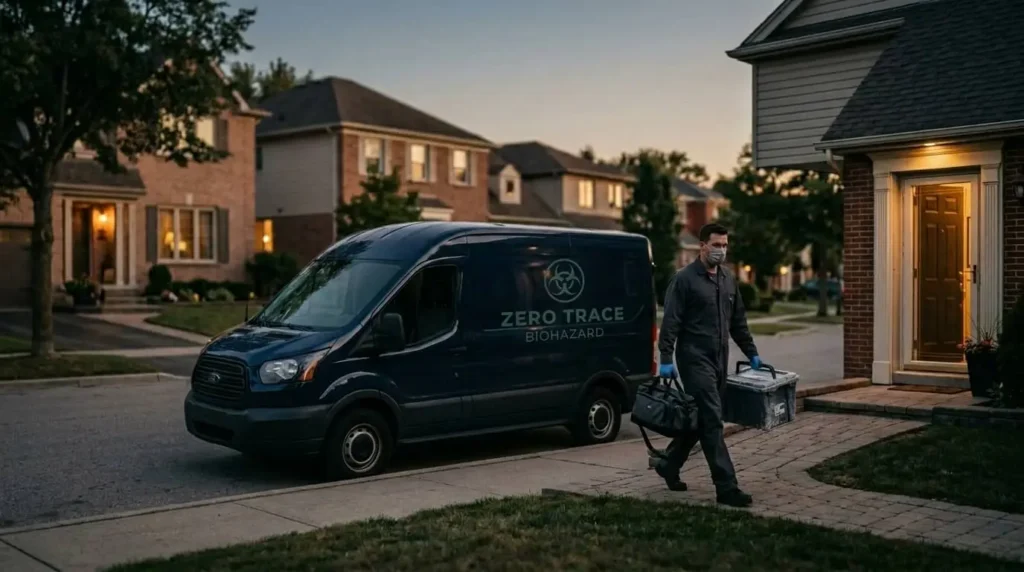
Asbestos Remediation Services — Certified Testing, Removal & Clearance Nationwide, $1,200–$30,000+
Zero Trace Biohazard provides fully certified asbestos remediation services for residential, commercial, industrial, and multi-unit properties across all 50 states. From initial AHERA-accredited inspection and laboratory testing through full containment removal, EPA-compliant waste disposal, and independent post-abatement air clearance certification — every phase of your asbestos remediation project is managed by a licensed supervisor with zero shortcuts and zero subcontracting. If your property was built before 1980, asbestos-containing materials (ACMs) may be present right now — and federal law requires a certified inspection before any renovation or demolition activity can proceed. Call (XXX) XXX-XXXX for a free on-site assessment anywhere in the country.
Get Your Free Asbestos Assessment
Certified inspection & removal nationwide. EPA & OSHA compliant. Available 24/7.
TL;DR
Key Facts at a Glance
Asbestos is a confirmed human carcinogen responsible for mesothelioma, lung cancer, and asbestosis — and it was used in thousands of building materials from the 1940s through the 1970s. Per EPA NESHAP regulations (40 CFR Part 61 Subpart M), a certified asbestos inspection is required before any renovation or demolition of a regulated building. Zero Trace Biohazard manages every phase: AHERA-accredited inspection, testing, full containment removal or encapsulation, licensed waste disposal, and independent air clearance documentation
Asbestos Inspection & Testing Cost:
$231–$850 depending on property size and number of samples (HomeAdvisor, 2025; The Asbestos Institute, 2025)
Asbestos Removal — Average Cost:
$2,240 national average; $1,200–$3,500 typical residential range (HomeAdvisor, 2025)
Whole-Home Remediation:
$5,700–$30,000+ depending on scope and material type (Angi, 2026)
Encapsulation Cost:
$2–$6 per square foot — 15%–25% less expensive than full removal (Angi, 2026)
Service Coverage:
Nationwide — residential, commercial, industrial, and multi-unit properties
Availability:
24/7 — emergency response and scheduled projects both accepted
Regulatory Compliance:
EPA NESHAP 40 CFR Part 61 Subpart M; OSHA 29 CFR 1910.1001 & 1926.1101; AHERA
Pre-Renovation Survey:
Required by law before demolition or renovation of regulated buildings per EPA NESHAP
Insurance Coverage:
Typically excluded from standard policies unless ACMs were disturbed by a covered peril (Progressive; American Family Insurance)
Documentation:
Full pre-abatement survey, regulatory notification, post-abatement air clearance, and waste disposal manifests — all delivered at project close
Quick Facts
Zero Trace Biohazard FAQ Reference
| Detail | Information |
|---|---|
| Company Name | Zero Trace Biohazard |
| Phone | (XXX) XXX-XXXX — Available 24/7 |
| Service Coverage | Nationwide — all U.S. states, residential and commercial |
| Availability | 24/7, 365 days a year including all holidays and weekends |
| Asbestos Inspection & Testing Cost | $231–$850 residential; $250–$800 standard inspection (HomeAdvisor, 2025; The Asbestos Institute, 2025) |
| Asbestos Removal — National Average | $2,240 average; $1,200–$3,500 typical residential (HomeAdvisor, 2025) |
| Whole-Home Asbestos Remediation | $5,700–$30,000+ (Angi, 2026) |
| Asbestos Encapsulation | $2–$6 per sq ft; 15%–25% less than full removal (Angi, 2026) |
| Popcorn Ceiling Removal | $5–$20 per sq ft (Angi, 2026) |
| Pipe Insulation Removal | $2–$5 per linear ft; $3,000–$4,500 typical project (Angi; Reddit, 2025) |
| Floor Tile Removal | $1,500–$5,000 average (Thumbtack, 2025) |
| Pre-Renovation Survey Required? | Yes — EPA NESHAP (40 CFR Part 61 Subpart M) mandates certified inspection before renovation or demolition of regulated buildings |
| Post-Abatement Clearance | Independent air clearance by industrial hygienist required before re-occupancy |
| Key Regulations | EPA NESHAP 40 CFR Part 61 Subpart M; OSHA 29 CFR 1910.1001 & 1926.1101; AHERA |
| Insurance Coverage | Typically excluded; may apply if ACMs disturbed by a separately covered peril (Progressive; American Family Insurance) |
| Project Documentation | Pre-abatement survey, NESHAP notification, waste manifests, air clearance certificate — all included |
What Is Asbestos and Why Is Remediation Required?
Asbestos is a group of naturally occurring silicate minerals — including chrysotile, amosite, crocidolite, and three additional fiber types — that were used extensively in construction materials, insulation products, and building finishes from the 1940s through the late 1970s because of their extraordinary heat resistance, tensile strength, fire-retardant properties, and low cost. Asbestos was eventually phased out of most applications following conclusive research linking asbestos fiber inhalation to a range of serious and often fatal diseases — but not before it was incorporated into an estimated 3,000 or more distinct building products, per the Minnesota Department of Health’s published list of common asbestos-containing materials.
Asbestos does not pose an immediate health risk when completely undisturbed and in good condition. The hazard arises the moment asbestos-containing materials are disturbed, damaged, cut, drilled, sanded, or demolished — releasing microscopic fibers into the air that are completely invisible to the naked eye and can remain airborne for hours before settling on surfaces throughout the property. Once inhaled, asbestos fibers become permanently embedded in lung tissue and the mesothelial lining of internal organs — and the diseases they cause can take 10 to 50 years to develop after initial exposure, per Mayo Clinic and ATSDR published health data.
Why Federal Law Requires Asbestos Remediation Before Renovation
Per the EPA’s National Emission Standards for Hazardous Air Pollutants (NESHAP), codified at 40 CFR Part 61 Subpart M, owners and operators of regulated buildings must have a thorough asbestos inspection performed by an AHERA-accredited inspector before any renovation or demolition activity. The inspection must be completed before any work begins — not during or after. Written notification to the appropriate regulatory authority is required at least 10 business days before the start of most regulated renovation or demolition projects, per EPA NESHAP notification requirements. Failure to comply carries significant civil and criminal penalties administered by the EPA and applicable state environmental agencies.
Beyond federal NESHAP requirements, OSHA Standard 29 CFR 1910.1001 governs asbestos exposure in general industry settings, and 29 CFR 1926.1101 governs asbestos in construction — requiring licensed abatement contractors, engineering controls, air monitoring, and detailed recordkeeping for all regulated asbestos work. Property owners, building managers, and contractors who allow asbestos disturbance without proper remediation face liability under both federal OSHA standards and applicable state regulations.
The Health Risks of Asbestos Exposure
There is no safe level of asbestos exposure. Per the National Cancer Institute (NCI) and the Agency for Toxic Substances and Disease Registry (ATSDR), all six recognized asbestos fiber types are classified as known human carcinogens by the International Agency for Research on Cancer (IARC). The diseases caused by asbestos exposure are serious, progressive, and in many cases fatal — and because symptoms can take decades to appear, exposure that occurs today may not be diagnosed for 20, 30, or even 50 years.
Mesothelioma
Mesothelioma is a rare and aggressive cancer of the mesothelial lining of the lungs, abdomen, or heart caused almost exclusively by asbestos fiber inhalation. There is no cure, and median survival after diagnosis is approximately 12–21 months. Mesothelioma risk is not directly correlated with smoking — even minimal asbestos exposure can cause the disease in susceptible individuals, per the American Cancer Society.
Lung Cancer
Asbestos exposure significantly increases the risk of lung cancer, and the risk multiplies substantially in individuals who also smoke. Per the National Cancer Institute, asbestos workers have been found to have lung cancer rates approximately 7 times higher than the general population. Unlike mesothelioma, lung cancer risk from asbestos does increase with smoking exposure.
Asbestosis
Asbestosis is a chronic, progressive, and irreversible lung disease caused by the accumulation of asbestos fibers in lung tissue, which triggers scarring (fibrosis) that progressively reduces lung function. Symptoms — including shortness of breath, persistent dry cough, and chest tightness — may not appear for 10 to 40 years after initial exposure, per Mayo Clinic and Cleveland Clinic published medical data. There is no cure and no way to reverse the scarring once it has occurred.
Laryngeal and Ovarian Cancer
ATSDR’s published health effects data confirms that asbestos exposure is also associated with increased risk of cancer of the larynx and ovary, beyond the more commonly known lung diseases. These associations are considered sufficient for classification as confirmed asbestos-related diseases by the IARC.
Who Is Most at Risk
Construction and renovation workers disturbing asbestos-containing materials without proper PPE and containment protocols
Property owners and occupants of pre-1980 buildings undergoing renovation without a pre-abatement asbestos survey
Building maintenance personnel who drill, cut, or disturb materials in older buildings without knowing whether ACMs are present
Family members of asbestos workers who experienced secondary exposure through fiber-contaminated clothing and equipment
Occupants of buildings with deteriorating ACMs where fibers are being released by age-related degradation without anyone’s awareness
Where Asbestos Is Found — Common ACM Locations in Buildings
You cannot identify asbestos by sight, texture, or smell. The only way to confirm whether a material contains asbestos is through professional inspection and accredited laboratory analysis. Never disturb a suspect material — call Zero Trace Biohazard at (XXX) XXX-XXXX for a certified inspection before any renovation, demolition, or disturbance activity.
Any property built before the early 1980s should be treated as potentially containing ACMs in multiple locations until a certified inspection confirms otherwise. The range of asbestos-containing materials used in residential and commercial construction is far broader than most property owners realize — per published lists from the Minnesota Department of Health, the U.S. EPA, and Mesothelioma.com, over 3,000 distinct products historically contained asbestos.
Common Asbestos-Containing Materials by Location
Mesothelioma
- Spray-applied textured coatings — popcorn ceilings and acoustic ceiling sprays
- Drop ceiling tiles and glued ceiling tiles
- Drywall joint compound and texture coatings applied before 1980
- Plaster and stucco finishes in older construction
Flooring
- Vinyl floor tiles — 9-inch and 12-inch tiles are strongly associated with asbestos content
- Sheet vinyl flooring and the felt or foam backing beneath it
- Floor tile adhesive — the black mastic adhesive under older tiles frequently contains asbestos
Insulation — Thermal and Acoustic
- Pipe and duct insulation — wrapping and lagging on steam and hot water pipes
- Boiler and furnace insulation
- Attic insulation — particularly vermiculite attic fill, strongly associated with asbestos contamination from the Libby, Montana vermiculite mine
- Spray-applied fireproofing insulation on structural steel beams
Exterior and Roofing
- Asbestos cement board siding — commonly called transite — used as exterior cladding
- Roofing shingles containing asbestos cement
- Roofing felt and underlayment
Mechanical and Utility Systems
- HVAC duct tape and insulation wrap on ductwork seams
- Gaskets and packing in older boilers and mechanical equipment
- Fire doors and fire-resistant partitions
- Electrical panel insulation and wiring insulation in some older systems
Friable vs. Non-Friable ACMs — Why the Distinction Matters
| Factor | Friable ACMs | Non-Friable ACMs |
|---|---|---|
| Definition | Can be crumbled by hand pressure — fibers release easily | Bonded in hard matrix — fibers released only when cut, drilled, or broken |
| Examples | Pipe insulation, spray fireproofing, popcorn ceiling coatings, boiler insulation | Floor tiles, roofing shingles, cement board siding, floor tile mastic |
| Fiber Release Risk | High — particularly dangerous when deteriorating or during renovation | Lower — but becomes high when cut, abraded, or demolished |
| Immediate Hazard if Undisturbed? | 2Moderate to High — especially if deteriorating | Low — when completely intact and not subject to disturbance |
| Removal Required Before Demolition? | Yes — always | Yes — non-friable ACMs must also be removed before demolition, per MEC Inc. and EPA guidance |
| Encapsulation Viable? | Sometimes — only if in very good condition and | More commonly viable when fully intact and in a stable location |
| not subject to any future disturbance |
Asbestos Remediation Services Zero Trace Biohazard Provides Nationwide
Asbestos Inspection & Pre-Renovation Survey — $231–$850
Every asbestos remediation project begins with a certified inspection. A licensed AHERA-accredited asbestos inspector conducts a thorough visual assessment of the entire property, identifies all suspect asbestos-containing materials, collects bulk samples from every suspect material type, and submits samples to an accredited laboratory for polarized light microscopy (PLM) analysis. Results are documented in a full pre-abatement survey report that identifies the location, quantity, condition, and friability classification of every ACM found.
This inspection is not optional when renovation or demolition is planned — it is required by law under EPA NESHAP regulations for regulated buildings regardless of building age. Per the EPA’s published guidance for building owners and managers, the inspection must be completed by a trained and accredited inspector before any work begins. Zero Trace Biohazard delivers the complete inspection report and supports all required regulatory notification filings.
What is included:
- Licensed AHERA-accredited inspector on-site assessment
- Bulk sample collection from all suspect materials
- Accredited laboratory PLM analysis
- Full pre-abatement survey report with location, quantity, condition, and friability data
- NESHAP regulatory notification preparation and filing support
- Written recommendation — removal or encapsulation — for each identified ACM
Asbestos Removal (Full Abatement) — $1,200–$30,000+
Full asbestos removal — also called abatement — is the complete physical removal of all identified ACMs from the property under a fully contained, negative-air-pressure work environment with independent post-abatement air clearance testing. This is the only method that permanently eliminates the asbestos hazard from the property — it removes the material, removes the risk, and provides a clean clearance record that has no future restrictions on renovation or demolition.
Asbestos removal costs range from $1,200–$3,500 for a standard single-area residential project, to $5,700–$30,000 or more for whole-property remediation, per HomeAdvisor (2025) and Angi (2026). Exterior work such as siding removal costs $50–$150 per square foot due to the higher labor and disposal requirements of large-surface exterior ACMs, per Angi (2026). Every Zero Trace Biohazard removal project is managed start to finish by a licensed supervisor with no subcontracting.
What is included:
- Full negative-air-pressure containment with HEPA filtration
- Wet removal methods to suppress fiber release throughout
- OSHA-compliant PPE for all technicians — respirators, protective suits, gloves, eye protection
- Complete removal of all identified ACMs within the project scope
- Double-bagged, labeled, leak-tight waste packaging per NESHAP requirements
- Licensed waste transport to EPA-approved disposal facility
- Complete chain-of-custody waste disposal documentation
- Independent post-abatement air clearance test by a third-party industrial hygienist
- Full post-abatement documentation package delivered to property owner
Asbestos Encapsulation — $2–$6 per Square Foot
Asbestos encapsulation is an alternative to full removal that involves applying a bridging or penetrating encapsulant directly to ACMs that are in good condition, not friable, and not subject to future disturbance. A bridging encapsulant creates a sealed membrane over the surface of the material, binding any loose fibers and preventing their release. A penetrating encapsulant is absorbed into the material and binds the internal fiber structure together from within. Per Angi (2026), encapsulation costs $2–$6 per square foot and is typically 15%–25% less expensive than full removal for comparable project scopes.
Encapsulation is not a permanent solution — it requires ongoing monitoring and maintenance, and if the encapsulated material is ever disturbed by future renovation, deterioration, or structural damage, full abatement will still be required. Zero Trace Biohazard provides an honest, written assessment of whether encapsulation is genuinely appropriate for your specific situation — we will never recommend encapsulation simply because it is less expensive if full removal is the safer long-term choice for your property.
What is included:
- Condition assessment of all target ACMs
- Preparation of surfaces per manufacturer specifications
- Application of EPA-appropriate bridging or penetrating encapsulant
- Documentation of encapsulated materials, location, and encapsulant type
- Monitoring plan and re-inspection schedule recommendations
- Monitoring plan and re-inspection schedule recommendations
- Written record for property file and any future sale or renovation disclosure
Asbestos Removal by Material Type — Detailed Cost Reference
Popcorn Ceiling (Textured Acoustic Ceiling) Removal — $5–$20 per Square Foot
Spray-applied textured ceiling coatings applied before 1978 very commonly contain asbestos at concentrations of 1%–10% or higher. Popcorn ceiling asbestos removal costs $5–$20 per square foot for professional abatement, per Angi (2026). A standard 1,500 sq ft home with textured ceilings throughout could range from $7,500 to $30,000 depending on fiber status, ceiling height, and structural complexity. Testing prior to any popcorn ceiling scraping project is essential — disturbing an asbestos-containing textured ceiling without containment creates a severe, whole-property contamination event.
Pipe and Duct Insulation Removal — $2–$5 per Linear Foot
Asbestos pipe insulation — commonly called lagging — was the standard insulation material for steam and hot-water pipes, boilers, and HVAC ductwork in buildings constructed before 1980. Removal costs approximately $2–$5 per linear foot, with typical residential projects costing $3,000–$4,500 depending on total footage and accessibility, per Angi and published Reddit community data (2025). Pipe insulation is a friable ACM — it can be crumbled by hand pressure — making it among the highest-risk materials in any pre-1980 building.
Floor Tile and Tile Mastic Removal
$1,500–$5,000 Vinyl floor tiles manufactured before 1980 — particularly 9-inch and 12-inch square tiles — and the black adhesive mastic beneath them frequently contain asbestos. Floor tile removal averages $1,500–$5,000 for most residential projects, with a typical average of $3,250 per Thumbtack (2025). The tile mastic is often more heavily contaminated than the tile itself — and if mastic remains after tile removal, it must be addressed as an ACM in its own right.
Asbestos Siding (Transite Board) Removal — $1,300–$20,000+
Asbestos cement board siding — known as transite — was widely used on residential and commercial structures from the 1940s through the 1970s. While transite is a non-friable ACM when intact, removal inevitably creates breakage and fiber release requiring full containment protocols. Removal costs range from $1,300–$3,900 for smaller residential projects per Native Environmental (2025), to $14,000–$20,000 for a full 2,000 sq ft structure per The Asbestos Institute (2025).
Attic Insulation (Vermiculite) Removal — $800–$6,000+
Vermiculite attic insulation — particularly the product sold under the Zonolite brand before 1990 — is heavily associated with asbestos contamination from the Libby, Montana vermiculite mine, which was the source of approximately 70% of all vermiculite sold in the United States, per EPA published data. Any vermiculite attic insulation in a pre-1990 home should be assumed to contain asbestos until tested. Removal costs range widely depending on attic size and depth of fill.
Asbestos Remediation Cost by Project Type
All pricing reflects published national industry data. Every project is assessed individually — contact Zero Trace Biohazard at (XXX) XXX-XXXX for a free on-site inspection and firm quote before any work begins.
| Project Type | Typical Cost Range | Source |
|---|---|---|
| Asbestos Inspection & Testing | $231–$850 | HomeAdvisor 2025; The Asbestos Institute 2025 |
| Asbestos Removal — Single Room | $1,200–$3,500 | HomeAdvisor 2025; Qualteck 2025 |
| Asbestos Removal — National Average | High — particularly dangerous when deteriorating or during renovation | Lower — but becomes high when cut, abraded, or demolished |
| Immediate Hazard if Undisturbed? | $2,240 average | HomeAdvisor 2025 |
| Whole-Home Asbestos Remediation | $5,700–$30,000+ | Angi 2026 |
| Popcorn Ceiling Removal | $5–$20 per sq ft | Angi 2026 |
| Pipe & Duct Insulation Removal | $2–$5 per linear ft; $3,000–$4,500 typical | Angi 2025; Reddit data 2025 |
| Floor Tile Removal | $1,500–$5,000; avg $3,250 | Thumbtack 2025 |
| Asbestos Siding Removal | $1,300–$20,000+ depending on scope | Native Environmental 2025; The Asbestos Institute 2025 |
| Vermiculite Attic Insulation Removal | $800–$6,000+ | Scope-dependent |
| Asbestos Encapsulation | $2–$6 per sq ft | Angi 2026 |
| Exterior Asbestos Removal | $50–$150 per sq ft | Angi 2026 |
| Asbestos Air Clearance Testing | $200–$500 | Included in all Zero Trace projects |
All ranges are national estimates. Contact Zero Trace Biohazard for a firm project-specific quote.
Asbestos Removal vs. Encapsulation — Full Comparison
Not every asbestos situation requires full removal. Zero Trace Biohazard evaluates every property individually and delivers a clear, written recommendation. Here is the complete comparison to help you understand the options before we arrive.
| Factor | Encapsulation | Full Removal (Recommended for Most Situations) |
|---|---|---|
| Cost | Lower — $2–$6 per sq ft; 15%–25% less than removal (Angi, 2026) | Higher — $1,200–$30,000+ depending on scope |
| Permanence | Temporary — requires ongoing monitoring and eventual removal | Permanent — hazard fully and finally eliminated |
| Future Renovation | Poor — encapsulated material must be abated before any future work that disturbs it | Excellent — no future restrictions after clearance documentation |
| Property Sale | May require disclosure and raise buyer concerns | Clean clearance certificate supports transparent property sale |
| Best Situations | Intact, stable ACMs in spaces with no planned future renovation or disturbance | Any renovation, demolition, damaged ACMs, friable material, or property sale |
| Post-Work Clearance Test | Not required | Required — independent air clearance by industrial hygienist |
| Long-Term Cost | May cost more over time — monitoring plus eventual removal | Lower total cost when permanence and liability are factored in |
| Regulatory Acceptance | Accepted in limited situations for stable, non-friable ACMs | Universally accepted — clears all regulatory requirements |
Not sure which option is right for your property? Zero Trace Biohazard provides a free on-site assessment and delivers a clear written recommendation — encapsulation or removal — based on the material’s condition, location, planned use, and your long-term property goals. Call (XXX) XXX-XXXX.
Zero Trace Biohazard's 7-Step Certified Asbestos Remediation Process
Every asbestos remediation project Zero Trace Biohazard performs follows a disciplined, fully documented process that meets every applicable federal and state regulatory requirement — from first contact to final clearance certificate.
01.
Initial Consultation & Project Scoping
Your project begins with a call to (XXX) XXX-XXXX). A Zero Trace Biohazard project manager gathers initial information about the property, its age, the nature of planned work, and any known or suspected ACMs. For emergency situations involving damaged or disturbed ACMs, immediate response dispatch is available 24/7. For planned renovation or sale projects, a site visit is scheduled to begin the formal inspection process.
02.
AHERA-Accredited Inspection & Laboratory Testing
A licensed AHERA-accredited inspector conducts a thorough on-site assessment of the entire property. Bulk samples are collected from every suspect material — ceiling coatings, floor tiles, pipe insulation, roofing materials, drywall compound, and any other potentially ACM-containing surfaces identified during the visual assessment. Samples are submitted to an accredited laboratory for polarized light microscopy (PLM) analysis, the industry-standard analytical method for identifying asbestos fiber type and concentration. Results are returned in a full pre-abatement survey report.
03.
Regulatory Notification Filing
For all regulated asbestos renovation or demolition projects, Zero Trace Biohazard prepares and files the required NESHAP notification with the appropriate regulatory authority — typically at least 10 business days before project start, per EPA 40 CFR Part 61 Subpart M. Notification includes the amount of regulated ACM present, the planned removal method, the start and completion dates, the name of the licensed abatement contractor, and the name of the approved waste disposal facility. We handle this paperwork entirely — you are not required to navigate the regulatory filing process alone.
04.
Site Preparation & Containment
Before any ACM is disturbed, the work area is prepared with full containment measures — plastic sheeting barriers covering all surfaces, doorways, and openings, and negative air pressure HEPA filtration units that continuously draw air through HEPA filters and exhaust it outside the work area, preventing fiber migration into unaffected areas of the property. HVAC systems serving the work area are sealed and de-energized. All workers don full PPE: half-face or full-face respirators with P100 filters, disposable Tyvek protective suits, multiple layers of nitrile gloves, and eye protection, per OSHA 29 CFR 1926.1101 requirements.
05.
Asbestos Removal & Waste Packaging
All identified ACMs within the project scope are removed using wet methods — materials are thoroughly wetted with amended water during removal to suppress fiber release and keep fibers from becoming airborne. Removed materials are immediately placed into labeled, leak-tight polyethylene bags — doubled-bagged per NESHAP requirements — and sealed with duct tape. Bags are labeled with the universal asbestos warning symbol and transported within the containment zone to a secure staging area for final disposal packaging. No ACM waste leaves the containment zone unpackaged.
06.
Final Visual Inspection & Post-Abatement Air Clearance Testing
Once all materials have been removed and the work area has been HEPA-vacuumed and wet-wiped to remove residual dust and debris, a visual inspection is conducted to confirm that no visible ACM residue remains. Following a satisfactory visual inspection, an independent third-party industrial hygienist — not affiliated with the abatement contractor — collects post-abatement air samples and analyzes them using Phase Contrast Microscopy (PCM) or Transmission Electron Microscopy (TEM) to confirm that airborne fiber concentrations meet regulatory clearance standards before containment is removed and the area is returned to normal use. If the site fails the air clearance test, the area is recleaned and retested — the project is not considered complete until clearance is confirmed.
07.
Waste Transport, Disposal & Documentation Package
All packaged asbestos waste is transported by licensed waste carriers to EPA-approved disposal facilities in full compliance with NESHAP waste disposal requirements under 40 CFR Part 61 Subpart M — asbestos waste must be sealed in leak-tight containers while wet, properly labeled, and disposed of only at approved sites. A complete post-abatement documentation package is delivered to the property owner at project close, including the pre-abatement survey report, NESHAP notification confirmation, waste disposal manifests with chain-of-custody records, post-abatement air clearance test results, and the final clearance certificate.
Who Is Legally Responsible for Asbestos Remediation?
Understanding who bears the legal and financial responsibility for asbestos remediation — property owners, landlords, tenants, or contractors — is one of the most common questions Zero Trace Biohazard receives. The answer depends on the type of property, the nature of the work, and the applicable federal and state regulations.
Property Owners and Homeowners
Homeowners who own and occupy their own property are generally responsible for asbestos remediation costs. Standard homeowners insurance policies typically exclude coverage for asbestos removal as a pre-existing environmental hazard, per Progressive and American Family Insurance published guidance. However, coverage may apply in specific circumstances where ACMs are disturbed or exposed by a separately covered peril — such as fire damage, storm damage, or water intrusion that requires tearing into ACM-containing walls or ceilings. Zero Trace Biohazard can help document these situations and support insurance claims where coverage may exist.
Landlords and Commercial Property Owners
Landlords are legally responsible for asbestos remediation costs in rental properties where ACMs pose a health risk to tenants, per BioRestore published legal guidance and AllLaw.com’s published analysis of landlord asbestos liability. Courts hold property owners liable for failing to inspect for, disclose, or remediate known asbestos hazards in rental properties. In commercial buildings, property owners and operators are responsible for compliance with all EPA NESHAP and OSHA asbestos standards — including maintaining asbestos management plans for buildings where ACMs are known to be present, per EPA.gov guidance for building owners and managers.
General Contractors and Developers
Any contractor engaged in renovation or demolition of a pre-1980 building is responsible for ensuring that an asbestos survey has been completed and that any regulated ACMs have been properly abated before disturbing those materials. Contractors who disturb ACMs without proper notification, containment, and disposal face OSHA violations, EPA penalties, and civil liability. Zero Trace Biohazard works directly with general contractors and developers to provide the pre-construction survey, abatement, and clearance documentation their projects require.
Best For & Not the Right Fit
Best For:
- Homeowners planning renovation or sale of a pre-1980 property who need a certified asbestos inspection, abatement, and clearance documentation before work begins
- Landlords and property managers who have identified or suspect ACMs in a rental property and need a legally compliant remediation solution that protects them from tenant liability
- Commercial building owners, schools, and facility managers with an asbestos management plan requirement or a known ACM condition requiring professional remediation
- Real estate professionals and buyers who need a pre-purchase asbestos inspection report or a post-remediation clearance certificate for a property transaction
- Property owners with damaged, deteriorating, or friable ACMs — popcorn ceilings, deteriorating pipe insulation, broken floor tiles — that are actively releasing or at risk of releasing fibers
Not the Right Fit:
- Properties built after 1985 with no renovation history involving older materials — ACMs are extremely unlikely to be present and a quick inspection will confirm this cleanly and inexpensively
- Property owners who want to disturb suspect materials without testing — we will never support undocumented disturbance of potential ACMs regardless of the circumstances
- Situations requiring only non-hazardous cleanup or general renovation — Zero Trace Biohazard specializes in hazardous environmental remediation, not general contracting or standard renovation work
- Property owners seeking compliance workarounds — all Zero Trace Biohazard work meets full EPA and OSHA requirements on every project, non-negotiably
Frequently Asked Questions
People Also Ask
How much does asbestos remediation cost?
Asbestos remediation costs range from $1,200 to $3,500 for a standard single-area residential project, with a national average of $2,240, per HomeAdvisor (2025). Whole-home remediation costs $5,700 to $30,000 or more depending on the number and type of ACMs present, per Angi (2026). Encapsulation costs approximately $2–$6 per square foot — 15%–25% less than full removal for comparable scopes, per Angi (2026). Call Zero Trace Biohazard at (XXX) XXX-XXXX for a free on-site assessment and firm quote.
Do I need an asbestos inspection before renovating my home?
Yes — if your home was built before the early 1980s, a certified asbestos inspection is required by law before renovation or demolition under EPA NESHAP regulations (40 CFR Part 61 Subpart M), per EPA.gov. You cannot identify asbestos by sight — the only way to confirm its presence or absence is through professional inspection and accredited laboratory analysis. Zero Trace Biohazard provides AHERA-accredited pre-renovation inspections nationwide.
What is the difference between asbestos remediation and asbestos encapsulation?
Asbestos remediation — full removal — permanently eliminates the ACM from the property and provides a clean clearance record with no future restrictions. Asbestos encapsulation seals the ACM in place with a barrier coating — it is 15%–25% less expensive than full removal but is a temporary solution that requires ongoing monitoring and will still require eventual removal if the encapsulated material is disturbed, per Angi (2026). Zero Trace Biohazard provides an honest, written recommendation on which approach is genuinely appropriate for your specific situation.
Is asbestos dangerous if I don’t disturb it?
Asbestos-containing materials that are in good condition, completely undisturbed, and not deteriorating do not actively release fibers and pose no immediate health risk. The hazard arises when ACMs are damaged, deteriorating, or disturbed by renovation or demolition. Per the U.S. Consumer Product Safety Commission, damaged or deteriorating ACMs should be professionally assessed and remediated immediately — do not wait for visible deterioration to worsen before calling Zero Trace Biohazard at (XXX) XXX-XXXX.
How long does asbestos remediation take?
A single-room or localized project — popcorn ceiling, pipe insulation, or floor tiles — typically takes 1–3 days including containment setup, removal, and post-abatement air clearance testing, per Angi published timeline data. Larger projects covering multiple rooms or multiple material types typically take 3–7 working days. Whole-property or complex commercial remediation can take 1–4 weeks or longer depending on building size and scope. Zero Trace Biohazard provides a firm timeline at the initial assessment.
Do I need to leave my home during asbestos remediation?
Yes — in most situations, occupants must vacate the affected areas of the property, and in some cases the entire property, for the duration of the abatement work and until the independent post-abatement air clearance test confirms that fiber levels meet regulatory standards. Zero Trace Biohazard specifies the required vacancy scope and duration during the project planning phase and confirms via air clearance testing that the property is safe for re-occupancy before anyone returns.
Does homeowners insurance cover asbestos remediation?
Standard homeowners insurance policies typically exclude asbestos remediation as a pre-existing environmental hazard, per Progressive and American Family Insurance published guidance. Coverage may apply in limited circumstances where ACMs are disturbed or exposed as a direct result of a separately covered event — such as fire damage, storm damage, or a covered water loss that requires opening ACM-containing walls or ceilings. Zero Trace Biohazard can help document these situations and support insurance claim submissions where coverage may exist.
Who is responsible for paying for asbestos remediation in a rental property?
Landlords are legally responsible for asbestos remediation costs in rental properties where ACMs pose a health risk to tenants or are required to be addressed under applicable regulations, per BioRestore and AllLaw.com published legal guidance. Courts have held property owners liable for failing to disclose, inspect, or remediate known asbestos hazards. Zero Trace Biohazard works directly with landlords and property managers to provide fast, compliant, fully documented asbestos remediation that minimizes legal exposure and returns properties to habitable condition.
What happens to the asbestos waste after it is removed from my property?
All asbestos waste removed by Zero Trace Biohazard is double-bagged in clearly labeled, leak-tight polyethylene containers while still wet, transported by licensed waste carriers, and disposed of at EPA-approved disposal facilities in full compliance with NESHAP waste disposal requirements under 40 CFR Part 61 Subpart M. Nothing is placed in standard trash receptacles. Complete chain-of-custody waste disposal documentation is delivered to the property owner as part of the post-abatement documentation package.
What is post-abatement air clearance testing and is it required?
Post-abatement air clearance testing is the process of collecting air samples from a remediated area — after all ACMs have been removed and the area has been cleaned — and analyzing those samples to confirm that airborne asbestos fiber concentrations meet regulatory clearance standards before occupants are allowed to re-enter, per EPA published guidance and UNYSE published asbestos air monitoring data. The testing is performed by an independent third-party industrial hygienist — not the abatement contractor — to ensure objectivity. Zero Trace Biohazard includes air clearance testing on every full abatement project and does not consider a project complete until clearance is confirmed.
Can I remove asbestos-containing materials myself?
In most regulated situations, no — asbestos removal in construction settings requires licensed contractors per OSHA Standard 29 CFR 1926.1101, which mandates specific training, engineering controls, PPE, air monitoring, and disposal procedures. Homeowners in some states may legally remove limited quantities of ACMs from their own owner-occupied properties, but this is strongly discouraged — the health risks, disposal requirements, and liability exposure make professional remediation by a certified contractor the only genuinely safe and legally protective option.
What is NESHAP and how does it affect my renovation project?
NESHAP stands for National Emission Standards for Hazardous Air Pollutants — it is the EPA’s regulatory framework governing asbestos emissions from demolition and renovation activities, codified at 40 CFR Part 61 Subpart M. NESHAP requires a certified asbestos inspection before any regulated renovation or demolition activity, written notification to the regulatory authority at least 10 business days before project start, proper removal and disposal of regulated ACMs, and documentation of all abatement activities. Failure to comply carries significant civil and criminal penalties. Zero Trace Biohazard handles all NESHAP compliance requirements — inspection, notification, abatement, disposal, and documentation — on every regulated project.
Protect Your Property, Your Family, and Your Legal Compliance — Call Now
Zero Trace Biohazard Certified Asbestos Remediation Services — Nationwide
- AHERA-Accredited Asbestos Inspection
- EPA NESHAP 40 CFR Part 61 Subpart M Compliant
- OSHA 29 CFR 1910.1001 & 1926.1101 Certified
- Licensed Waste Transport & EPA-Approved Disposal
- Independent Post-Abatement Air Clearance Testing
- 24/7 Availability — Emergency & Scheduled Projects
- Free On-Site Assessment — No Obligation
Serving residential, commercial, industrial, and multi-unit properties across all 50 United States.